2030 by 2030:
Digital Labs
for Every
School.
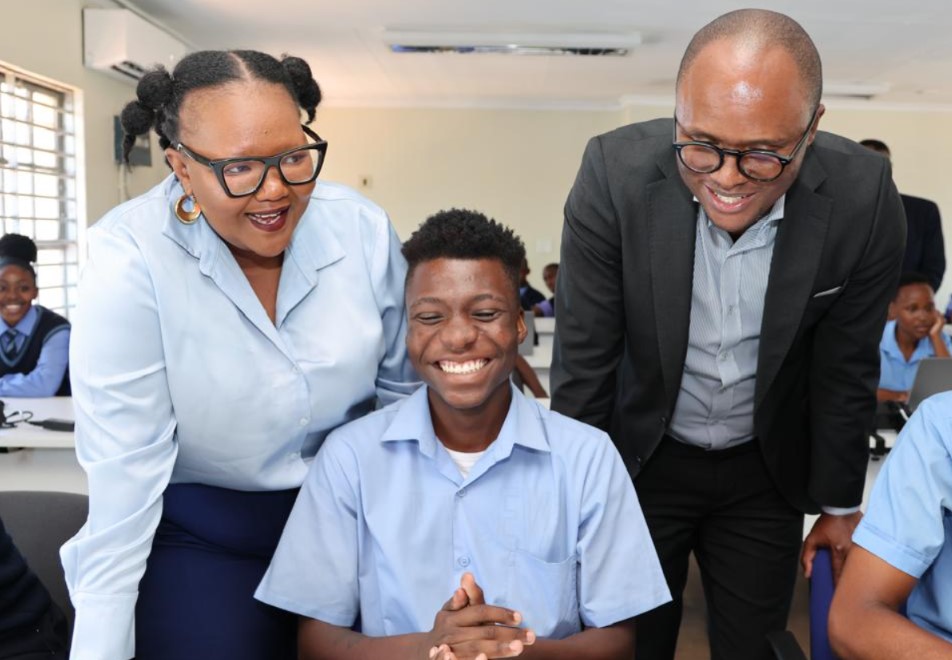
Ministers Siviwe Gwarube and Solly Malatsi with learners at Phefeni Senior Secondary School, Soweto — February 2026. Photo: Department of Basic Education / DCDT.
South Africa has a problem that no one talks about loudly enough. Thousands of public schools across the country still have no functional computer lab. In communities where the Fourth Industrial Revolution is not a buzzword but a lived survival question — where a matric certificate without digital skills is increasingly a certificate to nowhere — this is not an infrastructure gap. It is a justice gap.
And for too long, the corporate response to this gap has been the same: a delivery truck arrives, desktops are unboxed, a ribbon is cut, photos are taken, and a BEE certificate is filed. Six months later, machines are collecting dust. There is no internet. No support contract. No training for the teacher. No one to call when something breaks. The lab becomes a storeroom.
We have seen it. We have been called in to fix it. And we refuse to repeat it.
"A digital lab without a sustainability plan is not an investment. It is a very expensive photo opportunity."
1ICT's 2030 by 2030 initiative is our answer to this cycle. Our goal is to deliver and refurbish 2,030 Digital Labs in South African high schools by the year 2030 — not as a once-off handover, but as a managed, maintained, monitored programme built on genuine public-private-community partnership. Every lab we touch will still be working on day 1,000. That is our commitment.
The Gap We Are Closing
The Department of Basic Education has made digital infrastructure a national priority. President Ramaphosa identified the rollout of ICT in schools as central to national development and social justice. Yet delivery has lagged behind ambition — not because of a lack of political will, but because the private sector has treated education CSI as a compliance exercise rather than a systemic intervention.
The result is a two-track education system: schools in affluent suburbs with fibre, devices, and tech-capable teachers — and schools in townships and rural areas where learners are preparing for a digital economy on paper and pen.
2030 by 2030 is built to close that gap at scale. Two tracks. One for schools that have an old lab that has been neglected. One for schools that have never had one at all.
Two Tracks. One Mandate.
Bringing Dead Labs Back to Life
Thousands of schools have computer labs that exist on paper but not in practice — broken machines, no connectivity, outdated hardware, no support. We do not write these off. We rebuild them.
- Full infrastructure assessment and audit before any spend
- Hardware refresh — repair, replace, and upgrade existing equipment
- Fibre or LTE connectivity installed and contracted
- Microsoft 365 Education licensing for learners and educators
- Teacher digital competency training (accredited, SETA-linked)
- 12-month managed support and monitoring included
First Lab. Real Future.
For schools that have never had a computer lab, we deliver a complete, ready-to-learn digital environment — from the electrical installation through to the first lesson. Nothing is left incomplete.
- Site readiness assessment and electrical/network infrastructure
- Full workstation build-out — desktops, UPS, peripherals
- Connectivity — fibre where available, LTE failover where not
- Microsoft 365 Education tenant setup and device enrolment
- CAT curriculum integration and educator onboarding
- Ongoing managed services — helpdesk, monitoring, maintenance
Capital Delivery + Ongoing Managed Support
Every 1ICT Digital Lab is funded in two stages. The capital investment covers design, procurement, infrastructure, installation, Microsoft 365 licensing, and initial educator training — a once-off contribution that builds the lab. The managed services investment covers everything that keeps it alive: remote monitoring, helpdesk support, on-site maintenance, hardware replacement, and annual educator upskilling. Without managed services, labs fail. With them, they thrive for decades.
Capital Partner
Once-off · R300k–R1.5m · Builds the lab
Sustaining Partner
Annual · R80k–R150k/year · Keeps the lab alive
The difference between Track A and Track B is not size or cost. The difference is context. What they share is the non-negotiable at the centre of everything we do: every lab must be functional, supported, and growing in impact five years after we leave.
Why This Is Different:
The Sustainability Framework
Every previous tick-box CSI exercise failed for the same reason — no plan for what happens after handover day. Our model is built around six sustainability pillars that make the difference between a photo opportunity and a real legacy.
Managed Services by Design
1ICT's core business is managed ICT services. Every lab we install is enrolled in a support contract — remote monitoring, helpdesk access, on-site response SLAs. Machines that break get fixed. This is not optional. It is baked into every partnership agreement.
Department of Education Integration
We do not operate around government — we operate with it. Each lab is formally registered with the relevant Provincial Department of Education and aligned to the CAT curriculum. DBE's EdTech division is a core co-owner of the programme outcomes, not a bystander at a handover ceremony.
Teacher Capability First
Hardware without a capable teacher is worthless. Every lab includes an accredited digital skills training programme for educators — structured, SETA-linked, and ongoing. We measure teacher competency improvement, not just equipment delivery.
Community Ownership Model
The School Governing Body, principal, and community representatives sign a shared stewardship agreement. The lab is not given to the school — it is entrusted to the community. That shift in framing changes how the asset is protected, maintained, and valued.
After-Hours Access
Wherever possible, labs operate beyond school hours — for adult learners, community members pursuing TVET courses, and youth not currently in formal education. One lab serves the learner in Grade 10 and the parent who needs to apply for a job online. This is how we multiply impact beyond the direct beneficiary count.
Annual Impact Reporting
Every corporate partner receives a structured annual impact report — learner numbers, educator certifications, uptime statistics, community usage data. This is your ESG evidence, your BEE verification documentation, and your internal communications content, all in one.
A Real Public-Private-Community Partnership
Sustainable impact does not come from one actor. It comes from a structured ecosystem where each stakeholder has a defined role, accountability, and genuine stake in the outcome.
Department of Basic Education
School selection, curriculum alignment, EdTech integration, and formal registration of each lab within provincial infrastructure records. Government co-ownership ensures continuity beyond any single funding cycle.
Corporate Partners & Funders
Capital funding, equipment procurement budgets, and annual CSI commitment. In return: verified BEE scorecard claims across CSI, Enterprise Development, and Preferential Procurement — with full documentation.
1ICT — Implementation & Management
End-to-end delivery: design, procurement, installation, configuration, educator training, and ongoing managed services. We are accountable for the lab working — not just for it being delivered.
Schools & School Governing Bodies
Stewardship, access control, community scheduling, and protection of the asset. SGBs are trained partners in the programme — not passive recipients of a donation.
Community Organisations & NPOs
After-hours programme facilitation, adult literacy initiatives, and community access coordination. Civil society partners amplify lab impact beyond the school gate — turning each lab into a community asset, not just a school facility.
Provincial Departments of Education
Gauteng, Western Cape, Eastern Cape and other provincial education departments serve as regional co-owners — ensuring each lab is integrated into provincial infrastructure plans, curriculum support structures, and district oversight beyond the national DBE mandate.
Connectivity & Technology Partners
ISPs, Microsoft, and hardware OEMs contribute connectivity, software licensing, and infrastructure — ensuring the lab is built on enterprise-grade foundations, not consumer-grade shortcuts.
The Business Case for Your Company
Partnering with 1ICT on 2030 by 2030 is not charity. It is one of the most efficient BEE investments available to a South African corporate.
| BEE Element | What You Claim | Points Available | Why 1ICT Maximises This |
|---|---|---|---|
| CSI / SED Socio-Economic Development |
Community education investment — 75%+ black beneficiaries across all labs | Up to 5 pts (Generic) Up to 12 pts (ICT Sector) |
Schools are in township and rural communities. Every beneficiary qualifies. Full impact documentation provided. |
| Enterprise Development | Contracting and supporting a 100% black-owned SME as primary implementation partner | Up to 15 pts | 1ICT is 100% black-owned and managed. Every rand paid to us counts at the highest ED recognition rate. |
| Preferential Procurement | Spend with a verified black-owned supplier (EME/QSE status) | Up to 25 pts 110% recognition |
As a 100% black-owned EME/QSE, 1ICT gives your procurement spend the maximum multiplier on your scorecard. |
| Skills Development Linked spend |
Educator training and learnership pathways linked to the lab programme | Up to 20 pts | SETA-accredited educator training can be structured as a skills development contribution for your company. |
One strategic partnership. Up to four BEE elements claimed simultaneously. With full verification documentation included in your annual impact report.
The Proof Is Already Built
Phefeni Secondary School, Soweto
"By modernising this computer lab and creating brighter, more engaging classrooms, we're not just upgrading facilities — we're opening doors. This lab will help prepare learners with the digital skills they need for the jobs of the future."
— Asif Valley, National Technology Officer, Microsoft South AfricaThis is our pilot. It is documented, ministerially endorsed, and media-verified. 2030 by 2030 is what happens when we do this 2,030 times — with the right partners.
Who We Are Looking For
We are actively seeking corporate co-funding partners who are ready to move beyond the tick-box and make a real, sustained commitment to digital education in South Africa. Whether you are a large enterprise looking to fulfil your CSI mandate meaningfully, an ICT company seeking aligned community investment, or a mid-market business wanting to make your BEE spend work harder — there is a partnership structure that fits your needs and budget.
We are not asking for a donation. We are offering a partnership — with defined deliverables, measurable outcomes, verified impact reporting, and BEE documentation that stands up to scrutiny. This is what responsible corporate citizenship looks like in practice.
The first cohort of schools is being selected now. The window to be part of the founding partnerships is open — but it will not stay open indefinitely.
R2,030,000,000.
In Five Years. For 2,030 Schools.
This is not a small CSI initiative. This is a national infrastructure programme. We are raising two billion rand to permanently close the digital divide in South African high schools by 2030. Every pledge moves the bar.
Register Your Interest.
Leave your details below and a member of the 1ICT team will contact you within 48 hours to discuss how your company can be part of the 2030 by 2030 initiative.